

One person owns the follow-up sheet. Usually it is the sales or operations head, already stretched across quotations, dispatches and month-end. The MD approves an AI pilot and hands it to that same person. Then a busy fortnight arrives, the data never gets cleaned, and the pilot stalls. This is how most MSME AI projects end. Nobody decides to cancel them. They just stop.
Quick Answer
MSME AI projects usually fail before the tool is ever switched on, because the business data sits in Excel sheets and WhatsApp groups, no one owns the workflow, and “success” was never defined. Budget is rarely the blocker. AI needs a structured process to work on. For businesses chasing leads and service tickets manually, this is where the effort is wasted, and a CRM with clean, owned workflows is what makes AI usable.
What does “failing before they start” actually mean?
It means the project had no real chance. The vendor demo went well. The budget was approved. Then three months later, the team is back on WhatsApp and the AI tool is a login nobody uses.
This is not a question of discipline. It is a question of structure.
AI lead scoring needs a lead list with sources and outcomes. AI ticket classification needs tickets in one place. AI email drafting needs to know which customer, which quotation, which stage. If those inputs live in five places, the AI has nothing to work on.
Why do MSME AI projects fail? Four reasons that have nothing to do with budget
Four workflow gaps commonly stop the project before the tool gets a fair chance:
- The data is not in one place. Leads sit in phone contacts and Excel. Complaints sit in WhatsApp groups. Quotations sit in Word files. Before any AI can score, classify or summarise anything, someone has to gather all this. That work is usually not budgeted, so it never happens.
- No one owns the workflow. The project is “the MD’s initiative,” but nobody is named to run it day to day. When the sales head travels, the pilot waits. When an engineer is pulled onto a breakdown, the pilot waits.
- The project starts with the tool, not the task. “We should use AI” is not a use case. “Our sales team calls every inquiry first-come-first-served, and the best ones go cold” is. The second sentence leads to AI lead scoring. The first leads to a demo and nothing else.
- No one defined what “working” looks like. If nobody decided that, say, response to a high-priority complaint should be faster, there is nothing to review in month two. The pilot drifts, and the team concludes AI does not work for their business.
Each of these is fixable. None of them needs a bigger budget.
Is your pilot waiting on one person’s Excel?
See where your lead and service data actually lives today.
Talk to Our Team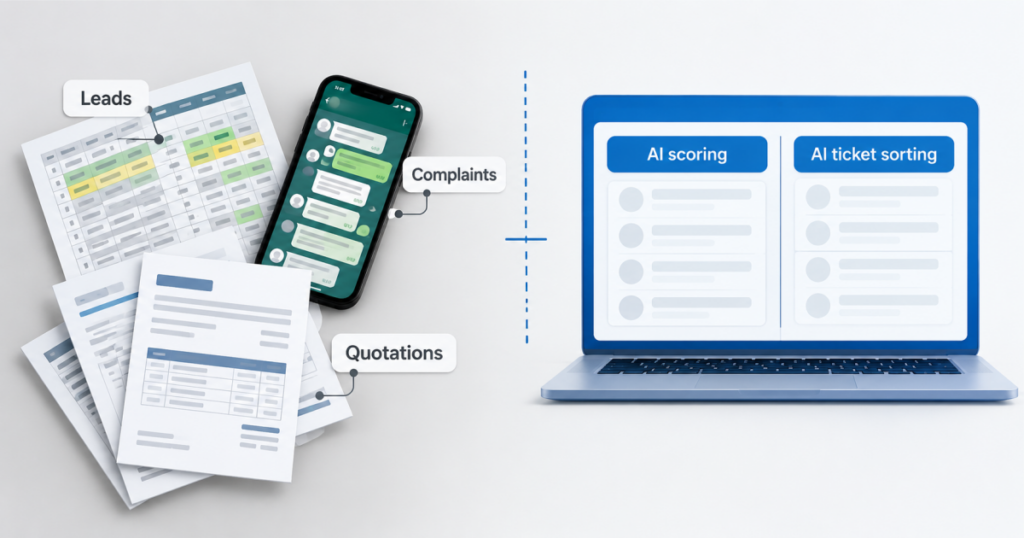
Fix the workflow first, then add AI
The order matters. Get the process into a system, assign an owner, then apply AI to one named step.
A structured CRM does the first part. Every lead gets an owner. Every follow-up gets a date. Every service ticket sits in one queue with a status. Management sees what is moving and what is stuck. TargetCRM is built for this gap: leads, follow-ups, quotations and support tickets in one place, instead of spread across Excel and WhatsApp.
The system owns the reminder, not a person.
Once that is running and the data is clean, AI has something to work on:
- AI lead scoring helps the sales team call the inquiries most likely to close first.
- AI ticket classification routes complaints to the right person without someone reading every message.
- AI email drafting prepares quotation follow-ups from the CRM record, so the sales team edits instead of starting from blank.
ECS does not sell AI as magic. ECS applies AI where it improves a real business workflow, reduces manual effort, or helps teams respond faster.
What should an MSME do in the first 30 days?
Start small and specific. For standard lead, follow-up and quotation workflows, a practical CRM setup can be live in around 30 days when scope, users and data are ready. AI comes after that, not alongside it.
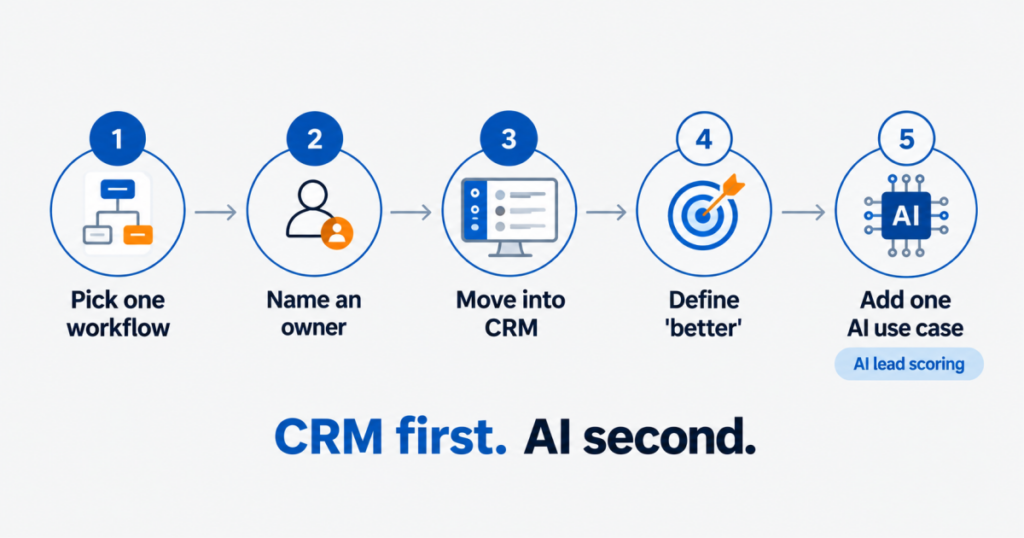
A simple sequence that works:
- Pick one workflow that hurts today: lead follow-up, complaint handling or quotation tracking.
- Name one owner who has time for it, and name a backup.
- Move that workflow into the CRM and run it for a few weeks.
- Decide what “better” means in plain words, for example fewer lost leads or faster complaint response, before turning AI on.
- Add one AI use case to that workflow and review it monthly.
This is slower than a big-bang AI rollout. It is also the version that is still running six months later. For background on how India defines these businesses, see the Ministry of MSME.
Want to see lead scoring on a clean pipeline?
We will walk you through how TargetCRM sets up the pipeline AI needs.
See How It WorksWhat this means for you
If your AI pilot is stuck, the answer is probably not a bigger tool or a bigger budget. It is one process, one owner and one system.
Fix that, and MSME AI projects stop being demos and start being part of the daily routine.
AI works when the workflow is already in order.
Start with the CRM setup. Add AI where it saves your team real hours.
Talk to Our TeamFAQ HUB
Most fail because the business data is scattered across Excel, WhatsApp and personal phones, no one owns the project day to day, and success was never defined. The tool itself is rarely the problem. AI needs structured, owned workflows to work on, and without them the pilot stalls within weeks.
Budget matters, but it is usually not the first blocker. The first blocker is unstructured data and unclear ownership. A small, well-scoped project on a clean workflow often delivers more than a larger spend on scattered data. Fix the process first, then size the budget around one named use case.
Move one painful workflow, such as lead follow-up or complaint handling, into a CRM. Name an owner and a backup. Run it for a few weeks. Define what “better” means in plain words. Only then add one AI use case, such as lead scoring or ticket classification.
Start with ones tied to daily work: AI lead scoring for sales, AI ticket classification for support, and AI email drafting for follow-ups. Each needs structured CRM data. Pick the one that matches your biggest manual effort today and run it for a month before adding another.
In most cases, yes. A CRM puts leads, follow-ups, quotations and tickets into one structured record. AI then has clean inputs to score, classify or draft from. Without that, the AI works on incomplete data and the team stops trusting its output.
For standard lead, follow-up and quotation workflows, a CRM can be set up in around 30 days when scope, users and data are ready. AI use cases are added after that and reviewed monthly. Complex customisation or data-heavy migration takes longer and is scoped separately.