

Quick Answer
Operational efficiency for SMEs means your sales, service, and support work runs on a structured system instead of individual memory and scattered Excel sheets — so the business does not depend on one person staying in the job. Growth without that structure only adds more leads, more customers, and more chaos to the same broken process. For teams still running follow-ups on WhatsApp and pipeline reports in Excel, this is where next quarter’s revenue quietly leaks away.
Why Growth Without Structure Stops Working for SMEs
One person owns the sales pipeline. Usually it is the founder, or the one Sales Head who has been there since year two. Every lead, every follow-up date, every “call back next week” lives in their head, or in a personal Excel sheet only they update. This works until it doesn’t. That person takes two weeks of leave, or gets pulled into a client escalation, or simply gets busy closing the one big deal in front of them. Follow-ups that were due on Tuesday get called on the following Monday. By then, the prospect has already spoken to two other vendors.
This is not a growth problem. It is an operational efficiency for SMEs problem wearing a growth costume.
For years, the standard SME playbook was simple: hire more salespeople, run more campaigns, chase more leads. Growth was the goal, and efficiency was something you would “fix later, once we scale.” The smarter move is to change the order of operations. Whether you run a fintech, logistics, consulting, or B2B services team, adding volume on top of an undisciplined process does not produce more revenue. It produces more dropped leads, more missed renewals, and more customers who feel forgotten.
Operational efficiency for SMEs comes first not because growth stopped mattering, but because growth without structure stops working.
The pain shows up in a few consistent places:
- Leads arrive from everywhere and land nowhere. Calls, WhatsApp enquiries, website forms, exhibition contacts, and referrals all come in through different channels. No one has a single view of where each opportunity stands.
- Follow-up depends on memory, not on the system. A salesperson says “I’ll call them tomorrow.” Tomorrow becomes next week. The lead goes cold, and no one notices until the deal is already lost.
- Support and service run on email and WhatsApp with no ownership. A customer issue gets raised in a chat thread, gets acknowledged, and then sits there with no SLA, no escalation path, and no one accountable for closing it.
- Management gets a different number from every person they ask. The founder asks for this week’s pipeline and gets three different answers from three different team members, none of which match what is happening on the ground.
- Growth initiatives add load to a system that was already at capacity. A new marketing campaign brings in fifty new leads. The team that was already missing follow-ups now misses more of them, because the volume went up and the process did not.
Each of these is a structural gap. Hiring a more diligent salesperson does not fix a pipeline that lives in someone’s personal Excel sheet. Asking the team to “try harder on follow-ups” does not fix the absence of a system that owns the follow-up date. The system owns the reminder, not a person.
Still tracking follow-ups in scattered Excel sheets?
See what a structured sales and service system looks like for a team your size.
Talk to Our Team
What Operational Efficiency for SMEs Means in Practice
Operational efficiency for SMEs is not a euphemism for cost-cutting, and it is not about doing less. It means the core revenue functions — lead capture, follow-up, quotation, service, and renewal — run on a system that holds the process even when a specific person is on leave, distracted, or focused elsewhere.
Concretely, that means:
- Every lead has a single owner and a visible status, regardless of which channel it came in from.
- Every follow-up has a date attached to it, and that date is tracked by the system, not by memory.
- Every support or service issue has a ticket, an owner, and a timeline — not a WhatsApp thread that scrolls out of view.
- Management can see pipeline, follow-up discipline, and ticket status without asking three different people for three different numbers.
This is not a question of discipline. It is a question of structure.
When that structure exists, growth initiatives compound instead of compete. A new campaign brings in fifty leads, and the system routes and tracks every one of them the same way it tracks the rest of the pipeline. Nothing extra falls through, because nothing was ever depending on one person’s memory in the first place. This is the core of how TargetCRM approaches lead and follow-up management for growing teams.
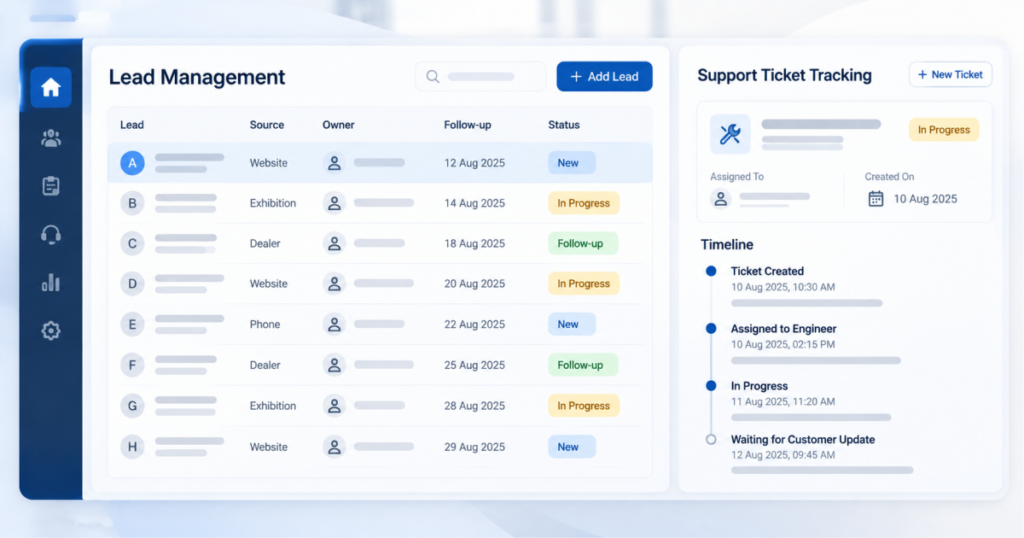
Structure first, then scale the growth on top of it
TargetCRM brings leads, follow-ups, quotations, and support tickets into one system your team will use every day.
See How It WorksWhat This Looks Like Inside a Real Sales and Service Team
For an Operations Head or Sales Head running a team of ten to thirty people, operational efficiency for SMEs usually starts in one of two places: the pipeline, or the support desk.
On the pipeline side, the fix is simple to describe and hard to do with Excel alone — every lead, from every source, lands in one place with an owner and a next action date. No lead sits unassigned. No follow-up depends on someone remembering a conversation from three weeks ago.
On the support side, the fix looks like a ticket instead of a chat thread. A customer issue gets logged once, gets an owner, and gets a status that management can see without pinging the person handling it. Escalations happen automatically when a ticket sits too long — not when a customer calls back angry. Explore how this works on the TargetCRM support ticketing page.
Neither of these requires a large team or an enterprise budget. For standard lead, follow-up, and support workflows, a system like this can be set up in around 30 days when scope, users, and data are ready. It requires a decision to stop treating structure as something to build “after we scale” — and start treating it as the thing that lets scaling work.
The founders who make this shift early are not the ones with the most leads. They are the ones whose leads don’t quietly disappear.
Growth is easier to sustain when the structure is already there.
Talk to our team about what operational efficiency looks like for a business your size.
Talk to Our TeamFAQ HUB
It means the core revenue functions — lead tracking, follow-up, quotations, and support — run on a system rather than individual memory. The process holds even when a specific person is unavailable, on leave, or busy with one big deal. That is what makes growth on top of it sustainable rather than fragile.
Because adding more leads and more campaigns on top of an undisciplined process does not produce more revenue. It produces more dropped follow-ups, more missed renewals, and more frustrated customers. Fixing the structure first means every new lead from the next campaign gets tracked, followed up, and closed the same way.
No. Operational efficiency for SMEs is about the process holding up under normal business pressure — leave, busy periods, staff turnover — not about spending less. Many businesses that focus on efficiency end up investing in the right system rather than in more headcount to chase the same scattered follow-ups.
Whichever one is causing visible pain first. If leads are going cold and follow-ups are inconsistent, start with the pipeline. If customer issues are sitting unresolved in WhatsApp threads, start with support ticketing. Both usually need attention eventually, and a practical CRM can handle them in one place, so you can start with one and add the other without switching systems.
No. Most SMEs need a practical CRM that handles leads, follow-ups, quotations, and support tickets in one place — not a large enterprise platform. For standard workflows, this kind of system can be set up in around 30 days once scope, users, and data are ready. Complex customisation or heavy integrations take longer and are scoped separately.
Look for these signs: management gets different pipeline numbers from different people, follow-ups depend on memory rather than dates, support issues live in WhatsApp with no ownership, and new campaigns seem to create more chaos instead of more closed deals. If two or more of these sound familiar, the gap is structural, and adding more people or more leads will not close it.