
Quick Answer
Predictive analytics for SMEs uses a business’s own past records, such as enquiries, orders, complaints and renewals, to estimate what is likely to happen next: which lead will convert, which customer may not renew. Software vendors talk about it now because more business data sits in cloud systems and the models cost less to run. For growing businesses whose history still lives in Excel and WhatsApp, the problem is not the prediction. It is that there is nothing reliable to predict from.
One sales head decides which enquiries get called first. It is judgement built over years, and it lives in that person’s head. Then the exhibition season arrives, the sales head is on the road, and two hundred enquiries land in the same week. The team calls them in the order they came in. The two serious buyers wait four days and place their orders elsewhere. This is the gap predictive analytics for SMEs is meant to close.
Why every software category suddenly says “predictive”
CRM, accounting, helpdesk, inventory, HR: open almost any product page today and the word “predictive” is somewhere near the top. Three things changed at once.
- Business data moved into systems. Enquiries, invoices and tickets that once sat in registers now sit in cloud software. For the first time, many businesses have a recorded history a model can read.
- The models got cheaper. Building a prediction used to need a data science team. Now it ships as a feature inside the software you already pay for.
- “Predictive” sells. It is an easier word to market than “better reports”. Some products have earned the word. Others have put a new label on an old chart.
Some of it is real. Some of it is a new word on an old report.
The way to tell the difference is simple: ask what decision the prediction changes, and what records it reads. Predictive analytics is only as useful as both answers.
Why predictive features disappoint most growing businesses
When a predictive feature fails, the model is usually blamed. More often, the records behind it were never complete. This is the part most guides on predictive analytics for SMEs skip. The same gaps show up again and again:
- Half the history was never entered. Enquiries that came by phone or WhatsApp went straight to a salesperson and never reached the CRM.
- Outcomes were not recorded. Deals were won or lost, but nobody marked which, or why. A model cannot learn from an ending it never sees.
- The data is split across systems. Enquiries in the CRM, orders in Tally, complaints in WhatsApp groups. No single record shows the full customer.
- Nobody owns the score. A lead is marked “likely to convert”, and no one is responsible for calling it first.
- There is too little history. A business that closes forty large deals a year may not have enough examples for a reliable pattern yet.
The model is rarely the weak link. The record is.
Is your enquiry history complete enough to predict from?
Talk to us about what your records can support today, and what to fix first.
Talk to Our Team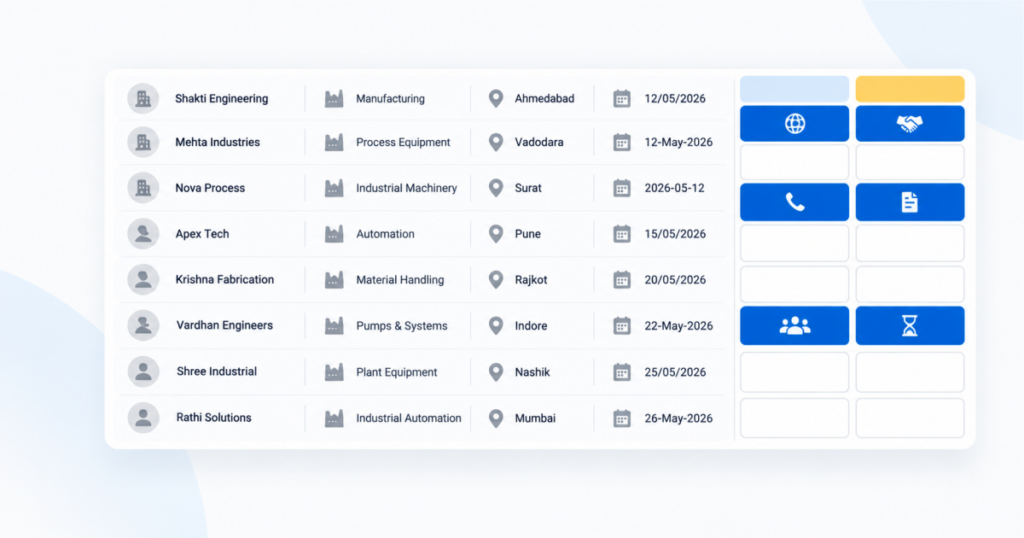
What predictive looks like when it works
In a growing business, useful predictions are small and specific. Each one feeds a decision someone already makes every week:
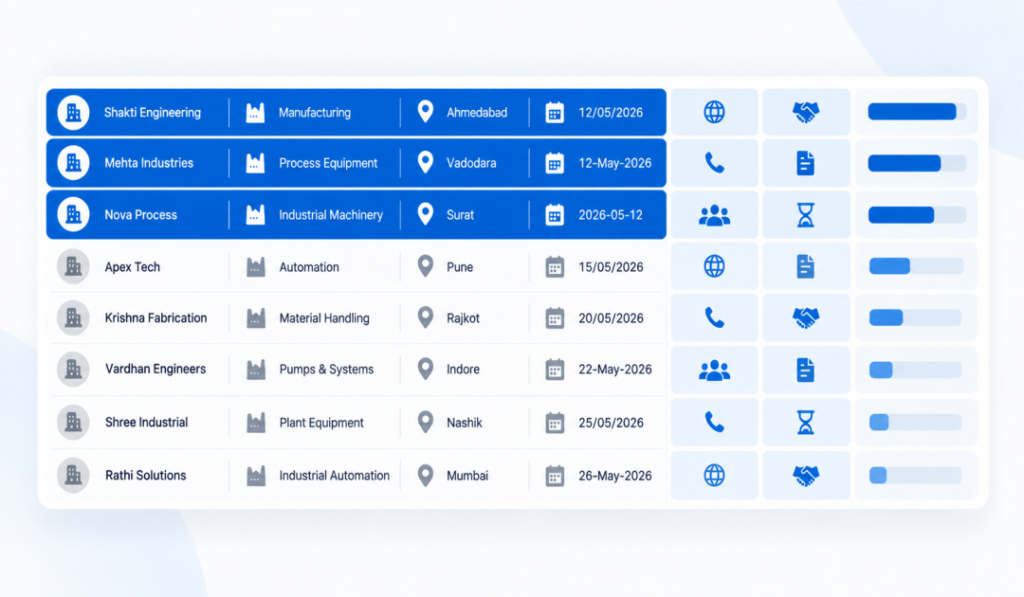
- Which enquiry to call first. AI lead scoring ranks new enquiries by how similar past enquiries turned out, so the sales team starts with the most likely buyers.
- Which AMC customer may not renew. Customers with rising complaints and fewer service visits can be flagged before the renewal date, not after it.
- Which quotation is stalling. Quotations that have gone quiet longer than similar won deals can be pushed back to the salesperson.
- Which customer needs a call from management. Accounts with repeated complaints can reach the Service Head before they reach a competitor.
A prediction is only useful if someone acts on it.
For machinery businesses, the AMC example depends on a clean record for every installed machine. Read more on installed base management and why that record comes first.
Four checks before you buy anything predictive
A sound approach to predictive analytics for SMEs starts with the records, not the tool. Run these four checks first:
- Does every enquiry reach the CRM? Phone, WhatsApp, exhibition and website enquiries should all land in one system, such as TargetCRM, with a source attached.
- Is every outcome recorded? Every lead and quotation should end as won or lost, with a reason.
- Is the history long enough? Look at how many complete, won-or-lost records you have. If it is a handful, start recording well now and predict later.
- Who acts on the score? Name the person who calls the top-ranked enquiries each morning before you switch any prediction on.
If all four answers are yes, predictive analytics for SMEs becomes practical. If not, the first project is the record, not the model.
Check whether your data is ready for prediction
We can walk you through what AI lead scoring needs from your CRM records, before you spend on any predictive tool.
Book a WalkthroughWhere a growing business should start
The simplest form of predictive analytics for SMEs is one prediction, not a platform. For most growing businesses, that is AI lead scoring, because enquiries are recorded more often than anything else and the decision it feeds, who to call first, happens every day.
ECS offers AI lead scoring as one of a small set of practical AI services. It works best for businesses whose enquiry history already sits in a CRM, which is why the conversation usually starts with the records. If your data still lives across an office server, laptops and WhatsApp, our cloud strategy guide covers that first step.
Years of CRM work have taught us that the businesses that get value from prediction are rarely the ones with the most advanced tools. They are the ones that recorded every ending.
FAQ HUB
It is the use of a business’s own past records, such as enquiries, orders, complaints and renewals, to estimate what is likely to happen next. For a growing business, that usually means practical questions: which lead will convert, which customer may not renew, which quotation is stalling. It works only when those records are complete and consistently kept.
More business data now sits in cloud software, and the models that make predictions have become cheaper to build into products. “Predictive” is also an easy word to market. Some features earn the label. Others are ordinary reports with a new name. Ask what decision the feature changes and what records it reads.
Some do, many do not yet. What matters is not the size of the business but whether enquiries and outcomes have been recorded consistently. A business with complete records of every lead and whether it was won or lost can start. One whose history sits in WhatsApp and personal Excel sheets should fix the records first.
AI lead scoring ranks new enquiries by how similar past enquiries turned out. It looks at details such as source, product, industry and response time, compares them with leads you won and lost, and gives each new enquiry a score. The sales team then starts each day with the enquiries most likely to become orders.
Not exactly. Predictive analytics is the goal: estimating what will happen next from past data. AI and machine learning are common ways of doing it. For a business owner, the label matters less than two questions: what decision does the prediction help with, and are the records behind it complete?
Make sure every enquiry reaches one CRM with its source, every lead and quotation ends as won or lost with a reason, and someone is named to act on the predictions each day. Without those three, a predictive feature has little to learn from and nobody to act on what it finds.